

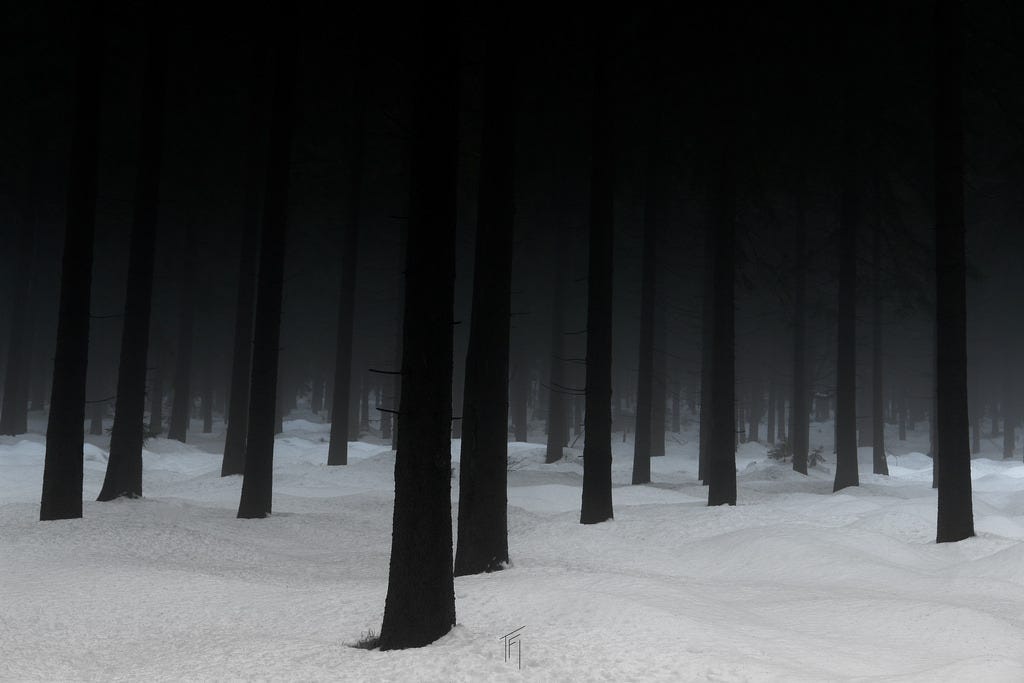
The temperature had dropped suddenly at sunset and a dry wind cut through the two overcoats and thin pants Leon wore. He had tied down his baseball cap with a woolen sweater, but his ears and nose were numb. His fingertips ached inside the coat pockets and the cold soaked into him, under his skin and into his bones. He had missed supper at the Rescue Mission on Ponce de Leon Avenue, “Ponce,” as the local Atlantans called the busy street, so he had resigned himself to a meal-less night and hoped that the bottle of Ten High bourbon he had just purchased would douse his hunger.
Buying the Ten High had caused him to miss supper. He had gone into Green’s Package Store with nearly ten dollars earned from a day of panhandling. The cold day had been good for begging. It had emboldened him to walk onto front porches and knock on oak and leaded glass doors in the neighborhoods that bordered Ponce, and present himself as a senior citizen and a veteran whose benefit payments were tied up in the red tape of the government. He could sound earnest and urgent on this account for it was not much different from the truth. For a while, even in prison, his Navy disability benefits continued, though over the years the laws changed, and he received less and less money. Upon his release from prison, he had enough saved that he could afford to rent a room and feed himself for six months.
But now he had no address and so, no bank account, no way to receive the payments. He had spent the summer on the streets, and though he battled mosquitoes, rats, stray dogs, and curious stares from children, he hadn’t found the life completely disagreeable. He had found a community, mostly men, mostly colored, many ex-cons and war veterans, and nearly everyone a consumer of one kind of drug or drink or the other.
He had learned to ask for only small, specific amounts of money—that day, it had been seven dollars and fifty cents—to buy a room for just one night at the Lutheran Shelter. It took him only a short while to realize that he could say the name of any shelter, or even make up a name, for those residents who dared open their doors had little knowledge of the boom town of the homeless that thrived just behind the screen of trimmed hedges and iron fences. Usually, he would be granted a dollar, but sometimes, especially on rainy or rare frigid days, he might receive the whole amount.
By six o’clock, he had raised more than nine and a half dollars and he went to Green’s to see what he could afford. He wanted Southern Comfort. He loved its sweetness. Considering the difficulty of his life, he felt he deserved sweetness. Why not in my last days, he thought, shouldn’t I have sweetness in my mouth? But he could only afford a pint of Southern Comfort or a fifth of Ten High. The Ten High was hell water and piss to taste, but it got him high, ten times high, and after deliberating between the sweetness he deserved and the high he wanted, he chose the Ten High. Still, he came up short, and the clerk, a pudgy middle-aged colored woman rolled her eyes at him and sighed.
He was about to take the bottle back to the shelf and choose something else, when a young white man behind him slapped a dollar on top of his pile of change. “There ya go, Pops,” the young man said. “Enjoy your evening, but be careful in this cold. Liquor will rob you of your warmth.” Leon thanked the man, nodding more than speaking to him. The man looked smooth and fresh and manifested a glow of confidence.
Just outside the door, he opened the Ten High and gulped down several mouthfuls. He looked behind him, through the plate glass of the storefront, to see the young man and the clerk laughing, the clerk pinching her nose and waving the air in front of her.
He walked along a cycling path that ran from Ponce, past Jimmy Carter’s Center, to Martin Luther King’s Center. Carter’s Center was set back in a pine woods, and passing it he glimpsed the circular concrete buildings through the drooping, frozen branches. He loved woods. He had grown up in them. The pines looked inviting, and he thought for a moment it might be a place to spend the night. In a light breeze, the trees would sway above and the sound of the breeze in the needles would rush like waves along a beach. He remembered Carter favorably, though he hadn’t voted for him—he hadn’t voted for anyone—he recalled that Carter was the first Georgian to become president. But he had never set foot on the campus of the Center. It was too cold to do so today, besides were guards.
A quarter mile past the Center, the trees opened up and he could see the silver towers of the midtown business district. How many people worked and lived in the towers he couldn’t imagine. Many thousands he thought. And on the parkway adjacent to the path was a stream of headlights and taillights, each car with a driver, hundreds of them. Along the path were apartment buildings with windows aglow. He imagined that there must be many thousands of people in the buildings. And yet, on the path, he was alone, plodding slowly with his bad foot. He was in a world apart from the world of fast cars and warm buildings.
Soon he came to an ice canopy, built to shelter path and parkway from ice falling from a television tower. The columns of the canopy and the guywires of the tower were wrapped in tangles of dormant kudzu vines which had wound up from a ravine. The ravine looked like a great wicker nest, and for a flash, Leon thought he might crawl over into it and sleep. His toes ached badly, and he stopped under the canopy, hoping for shelter from the wind. But the wind tunneled through the long canopy more fiercely than it had blown when he was in the open. Another quarter mile, he came to his home for that night in the girders of the Highland Avenue Bridge.
The bridge crossed the parkway at an angle and the girders ran close to the ground for about one hundred feet, creating a cavernous space under the roadbed which the girders divided into two large chambers. The chambers were accessible from the path, except that the designers of the bridge, apparently realizing the attractiveness of the spaces as habitat, had fenced them off with a sturdy chain link, which long ago had been bent open to allow people to climb up the fence and crawl over the top. In the summer, the concrete vaults were cool, a dank retreat from the sun, but in winter, though sanctuaries from the wind, they held onto the cold. Leon saw the flicker of a flame coming from deep under the bridge. Carefully, slipping his dead foot inside the links, he climbed and shimmied over the fence. He could not stand fully for the low ceiling as he made a passage around broken glass and discarded cans to the back of the chamber.
The flame came from behind a teepee made from a discarded carpet and corrugated boxes. Smoke vented from the teepee and collected between the girders. Leon called out tentatively and took the Ten High from his pocket, ready to share in exchange for warmth. He was greeted with more of a grunt than a welcome, but the colored man who looked out of the teepee, waved him underneath, and gestured for him to sit down next to the fire. Leon set the bottle of Ten High in front of him, and held his hand over the small flame burning bits of trash. It was more smoke than fire. His fingers ached sharply, and he pulled his hands back, and tucked them under his arms.
“Don’t warm up too fast,” the colored man said, the vapor of his breath mixing with the smoke. In the firelight, his sharp cheekbones were exaggerated, and his face, patched with mats of lint colored beard, looked devilish. He was swaddled in dirty blankets, and like Leon wore a baseball hat, tied to his head with old clothing. “When they freeze, it hurts twice as bad to thaw them. Do it slow.” The man nodded at the bottle, and Leon grasped it around the neck with his stiff fingers and handed it to him. The man drank, and handed it back. “Rot gut. Good ole rot gut. Not supposed to drink when it’s cold like this. Say it’ll make you lose heat.”
They passed the bottle back and forth for a few minutes, each swigging deeply, grimacing as they swallowed. In a few minutes, Leon began to shiver, and the man handed him one of the torn blankets. Following the man’s instructions, he draped the blanket over his head and wrapped it around his torso. His ankles and feet in torn sneakers lay unwrapped. He felt warmer.
Neither man spoke much, but passed the bottle back and forth and gazed at the paltry flame until the flame became an ember. Then the man tore a flap from the cardboard box that was a part or their shelter and rekindled the fire. He grumbled as he worked, and Leon followed bits of the man’s speech as he drifted in and out of a pleasant sleepiness. The man considered which was best that they should burn all the cardboard to make a big fire or hold it close to their bodies to keep warm. After a few minutes, Leon realized the man was not simply speculating, but asking his opinion. “I… don’t know,” Leon said. “I don’t care.”
“I thought this was going to be a good place, here. I have spent many a cold night under bridges, but man, I never seen it fuckin’ cold like this.”
“Kodiak,” Leon said, remembering one of the ports of call from his Navy days. He smiled, “Eskimo girls, all dressed in fur.” He had dated one of the Indian girls. Her name was Kallee, or something like that. She was plump and warm to lay against. She had wanted them to marry and for him to take a job at the base which was being converted to a Coast Guard Station. I would be sitting by a warm stove, now, he thought, with a fat, brown grand baby in my lap.
After a moment the man said, “I ain’t no Eskimo.” He pulled down more of the cardboard, slowly tore it into strips and fed it to the flame, but now they were more exposed to the open, and he suggested that they move closer together. They would have to share the blankets, and pull a stiff piece of carpet over them like a lean-to. Stiffly Leon moved. His joints ached and he complained.
“Long as they aching,” the man said, “then at least you living.”
They resettled, their backs against the concrete wall of the cavern and pulled the carpet over them. The flame, now burning brightly, smoked up the lean-to, making it difficult to breath. But the smoke was warm, and Leon felt better for it.
“I should’ve gone down to the shelter,” the man complained. “At least I would have been warm. But I don’t like it in there, all cramped up with a million people. And they rob you blind if you don’t watch them. Bunch of crackheads.” He chuckled and took a mouthful of bourbon. “At least I am not a crackhead. Weed, now. Love me some weed. Did time for heroin. ‘It’s my wife and it’s my life’—Those are song lyrics. But true, you don’t feel no pain on heroin. I’d do time again for it if I had some right now. But times are different now. We got ourselves a black president, an A-fri-can-A-mer-ri-can. Didn’t think I’d live to see it. A black man father of our country.”
The man’s voice seemed to drift, and Leon imagined his father. Not the father of our country, but a country father. The image of the man appeared before him in the teardrop of the flame, dressed in baggy khakis, a sworn flannel shirt even in the summer, and a straw fedora. He held an axe. Ooh, the axe.
Yes. The axe.
“When I was a little boy,” the man said, my teacher said to me, you smart. You can become president of the United States if you try. You just gotta want to. Shit. It takes more than trying—a whole lot more than what I had coming out of Summerhill, but now, a goddamn black man is president of the United States of America.”
“That’s good,” Leon said absently. He tried to straighten, to face the vision of his father. He propped his head against the concrete wall, but could not stop himself from rolling, sliding against the man.
“You all right?”
“My Daddy…” Leon said. “My Daddy was a colored man.” Embarrassment warmed his face, but quickly faded. He didn’t know why he had said it, but it was right. Colored people had it hard. His Daddy had had it hard.
The man burst out laughing. It was a deep, heaving laugh that ended with a fit of coughing. “Man. You crazy.” The man found the bottle between them and swigged. “You shitting me. Ain’t you?”
Leon tried again to sit up straight, but slipped back against the man’s shoulder. The shoulder felt numb, comfortable against his cheek. “I guess I’m just a little high.”
“I’m cuttin’ you off.” The man chuckled, drank again from the bottle. A siren rushed along the parkway. “People out dying tonight. In this fuckin’ cold. Sometimes it’s the heat that kills you. Sometimes it’s the cold.” He added more cardboard to the flame, which was burning low.
“People are always dying,” Leon said. The image of his father flickered with the flame, the axe, swung back across his shoulder and his face blistering with anger. Some of us are born dead. He was not dead, nor had he been born dead, though for some time now, he thought, he might as well be dead. Still, life could have been worse. He had seen worse. He had seen those who were always hungry, beaten down—murdered. In spite of his term in prison, he had never murdered anyone, though plenty of times, he had wanted to.
The man added cardboard to the fire, making it flare up. It began to singe the carpet and it smelled like burning plastic.
“Maybe we need to go out and flag somebody down. But they won’t stop. They won’t stop for us. Sure as hell, they won’t stop for me. Maybe, Mr. man-with-the-colored-daddy, they’d stop for you. But they won’t stop for me. And there’s a fuckin’ black president.” Leon’s body rolled away from the man, nearly knocking down the lean-to, but the man pulled him back, pulled him close. “You just lay up against me. You can share my body heat.” But the man didn’t seem to have any body heat. The cold was no longer cutting, rather it pushed down on him, weighed him down. “Here.” The man held the bottle to Leon’s lips, and he managed to sip a little without lifting his head. He let the liquor rest in his mouth for a while before he swallowed it.
“You can kill it, “Leon said. “I want to go to sleep.”
“Thank you, my brother!” the man said. Leon closed his eyes. He heard the man guzzling the liquor and talking to himself. Some of the things the man talked about sounded familiar, of warm dinners, and warm beds. Some things were odd and unfamiliar—”He drink whiskey/ Poncho drink the wine”—“I know you’re working for the CIA/ They wouldn’t let you in no Ma-fi-a”—“The world is a ghetto.” What did that mean? Leon thought. The world was… he tried to imagine what the world really was—it was so many things—a prison, a shipboard galley, a gravel beach in Alaska, a forest in the piedmont. He had been to all of those places in the world. Did he regret any of it? Yes, some of it—many things, but there were many good things, too. He wished suddenly that he had had a wife and children—those fat, brown grand babies.
He had long forgotten what he and his father had argued about that day, something…something…maybe about work, or money…about work…about splitting the wood. His father had wanted his help to split the oak blocks. His father had a strong swing and the axe struck open the block with a loud chop and a splinter, releasing the sour smell of sap. His father had a good rhythm, swaying like a tree in the breeze and arching the axe over his shoulder like a wave curling towards the shore. But then there were filthy words between them, and he said something that broke his father’s rhythm. Both leaned toward one another, and his father raised the axe. Leon saw that his father’s face had swollen, his eyes were bulging and fierce. Leon stepped back, his breath caught up in his chest.
Then a chuckle of a scream came from behind him. It was his mother. The axe fell, cleaving a chunk off of the chopping block. His father stared for a moment, turned and was walking away.
Son-of-a-bitch!
Leon grabbed the axe handle by the knob, and cleanly, making his own rhythm, swung it behind him, butt leading, and backwards over his shoulder and let it go. It passed over his father’s right shoulder and landed with a thud several feet in front him. His father froze, then continued toward the axe. His mother had reached them, and stood between them.
The following day, his mother signed consent papers and he joined the Navy.
The next and last time he saw his father was at his mother’s funeral. He had arrived late and missed the service. The old man was still standing by the gravesite as the diggers threw clods of clay that drummed against the coffin. Looking up, the old man opened his arms. They embraced. “Come on back home,” his father said.
“Ok,” he said. But he never did.
If only he had had a family. Grand babies. But he was too much of a rambler—Lord, I was born a ramblin’ man, he remembered the words of a song, one often played in prison. Trying to make a living and doing the best I can. That was it. He was doing the best he could. What else could he do? The world was so big, and he was so little in it. What else could be expected of him? He was, as the song said, just rolling down highway forty-one.
Then, for a while, he thought of nothing. He was sure he hadn’t slept; he hadn’t been aware of thinking or dreaming. It was dark; the fire was cold. The man whose body he was cuddled against breathed shallowly. He closed his eyes, pushed himself closer to the man, drawing his stiff limbs together into a ball. Gradually he began to feel warm, and when he opened his eyes again, bright dabbles of light cascaded around him. He was in the forest he loved, in a rivulet of sparkles. Then he rose up, floating, and saw the great forest from a thousand feet above, the various greens of all the trees and the fields, the jades and olives of the tangles of vines and branches mixing like the currents in a great green ocean.
When he awoke, he was face to face with the man. The man’s eyes were open, but he stared at nothing. It was hard to look at the dead man, especially with his lips twisted and crusted with froth. Poor colored son-of-a-bitch. Leon looked away and slowly sat up. Sunlight streaked under the roadbed, forming bars along the abutment. He would try to get breakfast at the Rescue Mission. Then he would go into the neighborhoods to beg. It would be a cold day again and the begging would be good.
***
NOTE: Under the Highland Avenue Bridge is still a shelter for homeless people. In fact, since this story was conceived about 15 years ago, the girders have become the site of a tent community. The City of Atlanta has been removing the people, mostly men, from such sites and housing them elsewhere with about 50% success as many of the transplanted people return to the bridges and other campsites.
This story was originally a draft of chapter 24 of my novel The Vain Conversation (USC Press, 2017). With guidance from the marvelous novelist Pam Durban, I deleted these scenes. In shaping this story, I considered an analysis of Chekhovian endings discussed in David Jauss’s essay, “Returning Characters to Life: Chekhov's Subversive Endings.” Here I try for a false climax that turns toward a chiastic ending, a repetition of the beginning of the story.

Be sure to visit the website, AnthonyGrooms.Substack.com, for more stories and poems. Click on “continue” to be directed the site.